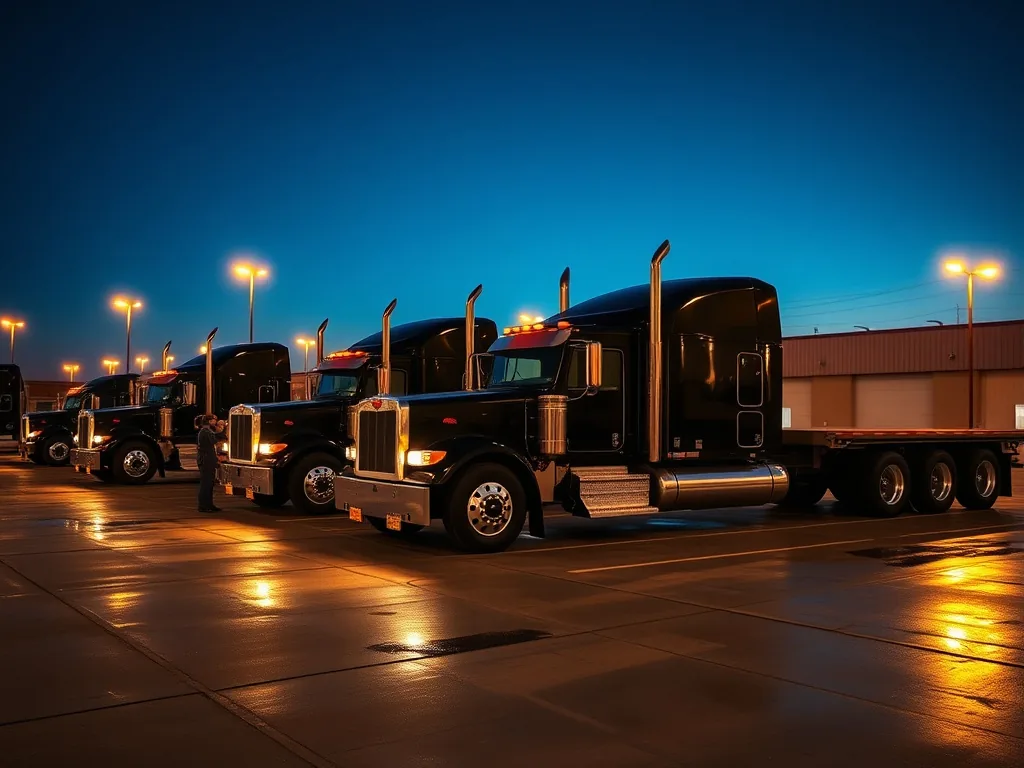
When a Hot Shot Operation Becomes a Fleet
The classic path: one profitable year, a second financed dually, a buddy in the driver's seat. On paper you just added a truck. To an underwriter, you changed species — from an owner-operator policy rated on one person you control completely, to a fleet account rated on drivers you hired, equipment you scheduled, and systems you may not have built yet.
What changes at truck two: every driver's MVR now co-rates the account, driver qualification files become an underwriting question, workers' comp likely becomes law rather than choice, and your certificate workload multiplies with every broker each truck hauls for. None of that is bad — it's just different, and the operators who treat it differently keep their loss runs clean and their pricing falling.
The core stack doesn't change: $1M primary liability with your filings, $100k cargo, and physical damage on every financed unit. It just gets scheduled across more trucks — and priced on the whole operation instead of one driver.
Fleet vs Per-Truck Pricing: Where the Discounts Actually Start
Straight talk: two trucks is not a "fleet discount." At two units you're mostly buying two owner-operator policies stapled together, and the premium says so. Real fleet economics start when the account gets big enough for underwriters to rate the operation — usually around three to five units.
| Fleet size | How underwriters see it | Pricing reality |
|---|---|---|
| 2 trucks | Owner-operator plus one — rated per truck, per driver | Little to no fleet credit; second driver's MVR moves the whole number |
| 3–5 trucks | A real small fleet — operation-level rating begins | Fleet credits appear; typically $8,500–$18,500 per unit for clean accounts |
| 6–10 trucks | Established account — loss runs and safety systems drive pricing | Best leverage; safety plans and telematics become real negotiating currency |
The per-unit number is earned, not given: it assumes clean MVRs across the roster, a claim-free loss run, and stable equipment values. One bad driver or one preventable claim can erase the fleet credit faster than any discount created it — which is why the next section matters more than this one.
Worth knowing as you plan growth: the new-venture surcharge that priced your first year applies to the MC, not to each truck. Adding units to an established, clean authority prices far better than the same trucks would under a fresh MC — one more reason to grow under the authority you've already seasoned.
Hiring Drivers: The MVR Rules Everything
Here's the sentence that saves fleets: hire on the MVR first, the handshake second. Your buddy may be a great guy and a solid hand, but if his record shows a DUI, a serious speed, or an at-fault from three years back, his MVR now prices every truck on your policy — and some carriers will simply refuse to add him, leaving you with a truck and no insurable driver.
The math is brutal because of how small the denominator is. A ten-truck van fleet can dilute one rough record; a three-truck hot shot fleet cannot — one driver is a third of the operation, and underwriters price him that way.
- Screen before you promise. Pull the MVR before the job offer, every time. Most fleet programs want drivers 23+ with 2+ years of verifiable experience and a clean recent record.
- Build driver qualification files. Application, MVR, medical card, road test, prior-employer checks — required by FMCSA once you have drivers, and the first thing an underwriter or a plaintiff's attorney asks for.
- Report changes immediately. An unreported driver in a wreck is a coverage fight you don't want. Every seat change goes to your agent the day it happens.
- Recheck annually. MVRs age badly in silence. An annual pull catches the violation your driver forgot to mention before renewal prices it for you.
One more hiring trigger with teeth: in most states, your first W-2 driver makes workers' comp mandatory — the sole-proprietor exemption dies the day someone else is on your payroll. The full breakdown of comp versus occupational accident, and what broker packets accept, is on our occupational accident and workers' comp page.
Trailers, Mixed Equipment, and the Class-8 Temptation
Hot shot fleets rarely scale symmetrically. You add a dovetail for equipment loads, a deckover for steel, maybe an enclosed trailer for freight that pays for walls. Every trailer needs to be scheduled with its own stated value — and once trailers outnumber trucks, ask about an "any owned trailer" endorsement, which covers whatever combination hooks up that morning instead of forcing you to match listed pairs.
If your trucks also pull trailers you don't own — power-only loads, dealer goosenecks, drop trailers — schedule non-owned trailer limits per power unit. How that coverage works, and why classic interchange usually isn't the right form, is covered on our trailer interchange page.
Adding one semi can re-rate the whole account
The Class-8 temptation is real: one used Peterbilt opens heavier freight. But many hot shot programs are written for medium-duty equipment, and adding a Class 8 can push the entire account out of hot-shot-rated programs into full Class-8 pricing — on every truck, not just the new one. Sometimes the semi still makes sense; sometimes it costs more in premium than it earns in freight. Model it with us before you buy, not after.
Safety Tech and Systems That Cut Fleet Premium
At one truck, underwriters rate your MVR. At five, they rate your systems — and systems are the levers you actually control at renewal:
- Dashcams on every truck. Road-facing cameras earn credits with many carriers, and the footage kills not-at-fault claims before they ever price your loss run.
- Telematics and ELD data. Hard-braking, speeding, and hours patterns are visible to you before they become claims — and shareable with underwriters as proof of a managed fleet.
- A written safety plan. Securement policy, tarping procedure, driver training log, maintenance records. For 5+ unit fleets this is genuine premium-negotiation currency, not paperwork theater.
- Claims discipline. Absorb the small stuff when the math supports it, document securement with photos on every load, and keep the loss run clean — the loss run IS the fleet's credit score.
More cost levers — deductible strategy, radius and commodity tightening, pay-in-full discounts — are in our guide to lowering hot shot insurance costs. Nearly every lever works harder at fleet scale, because every point of rate applies to every unit.
COIs Across Many Brokers, Without the Bottleneck
Three trucks hauling for a dozen brokers means certificates constantly in motion — new certificate holders, renewals hitting every packet at once, a broker demanding corrected wording while your driver sits at a shipper. Slow COIs don't just annoy dispatch; they un-book loads.
This is an agency-selection issue as much as an insurance issue. We issue broker-specific certificates same-day, keep your certificate-holder list on file so renewals update every packet automatically, and pick up the phone when a broker calls to verify coverage. Your dispatcher should be booking freight, not chasing paperwork.
Two certificate details worth standardizing across the fleet: make sure the named insured matches your MC's legal entity exactly on every cert, and keep one master list of which brokers require additional-insured wording versus certificate-holder-only. Fleets that standardize this once stop losing loads to packet rejections entirely — the most common rejection reasons are wording problems, not coverage problems.
Get a Fleet Review
Whether you're pricing truck number two or restructuring six, a fleet review is the same exercise: every driver's MVR, every unit's value, every trailer scheduled right, workers' comp handled, and the whole account positioned in a program that rates hot shot like hot shot — not like a Class-8 fleet that happens to be small.
Request your fleet quote or call 844-967-5247. Bring your driver list and equipment schedule, and we'll tell you where the account prices today and what would make it price better next year.